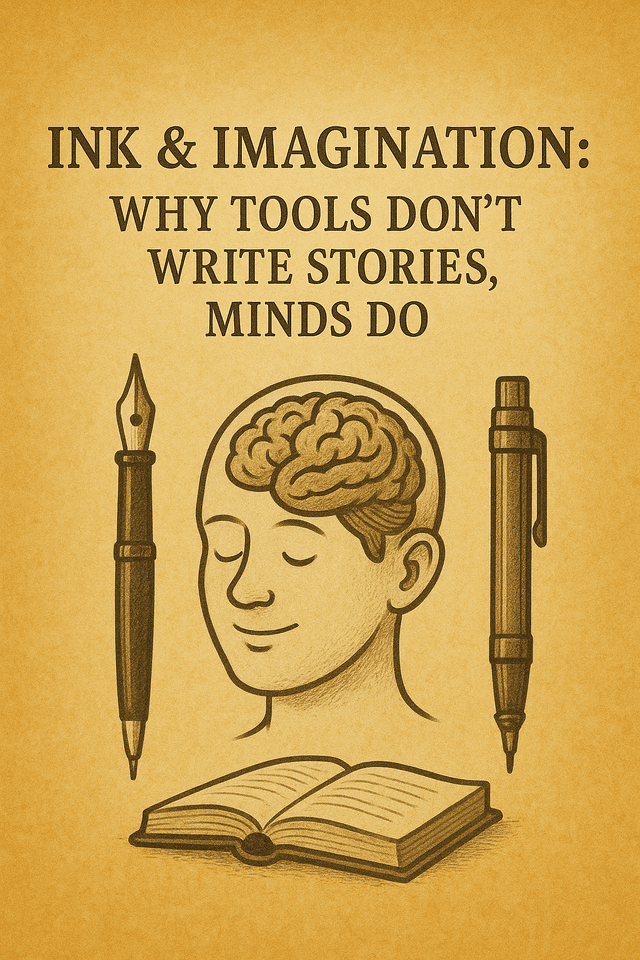
Ink & Imagination: Why Tools Don’t Write Stories, Minds Do
Because your mind is the real fountain pen — everything else is stationery.
Once upon a keyboard, a writer sat staring at their screen, convinced that buying a new writing app would magically unlock a bestselling plot. New font? The story may flow. New notebook? The characters may likely behave. New AI tool? Maybe it’ll write the book AND do the Magic.
Writers, let’s be honest — we all love our tools. We love the feel of a good pen, the clack of a laptop, the smooth seduction of a productivity app promising, “This time… this time you will write.”
But here’s the truth wrapped in a ribbon of reality:
Tools don’t write stories. Minds do.
Stories begin long before fingers touch keys.
They begin in you — in the wandering, observing, daydreaming, chaos-making human mind.
Let’s explore why.
The Tool is the Vehicle. The Mind is the Driver.
A fountain pen never sat in a café and thought,
“Hmm, what if a detective fell in love with the thief he’s chasing?”
A laptop never typed,
“What if time travel existed but only on Sundays?”
AI never stood under a streetlight at 2AM, heartbroken, imagining a poem into existence.
Tools help you express. But the story?
That spark, that question mark, that emotional turbulence that becomes art — that is all you.
Give a typewriter to ten people.
You’ll get ten wildly different stories.
Why?
Because the typewriter isn’t the storyteller — the soul behind it is.
Curiosity: The Original Story Generator
Every story begins with someone asking a question nobody else thought of.
“What if animals could vote?”
“What if planets had personalities?”
“What if mothers were secret superheroes?”
“What if heartbreaks were actually portals?”
Curiosity is your inner electricity.
Tools simply conduct that current.
Great writers train their curiosity like puppies — let them wander, sniff around life, make messes, and occasionally steal your socks.
Observation: Where Stories Hide in Plain Sight
Writers are secret detectives.
While the world scrolls, writers stare.
While people speak, writers listen to what isn’t being said.
While crowds move, writers notice the only person standing still.
A writer sees:
- ✨ the old man talking to pigeons as if they were old friends
- ✨ the child dragging her teddy like it’s seen things
- ✨ the woman on a bus staring at her wedding ring like it’s a question
- ✨ the smell of a bakery that triggers a childhood memory
- ✨ the silence between two people who used to be close
You don’t need fancy software to catch these stories.
Just eyes that linger and a heart that wonders.
Life Experiences: The Real Ink of Storytelling
We often think inspiration comes from exotic sunsets and faraway travels. But the most incredible stories?
They’re born from the ordinary — the tiny emotional earthquakes that shape us.
Your heartbreak becomes a poem.
Your awkward office meeting becomes a satire.
Your grandmother’s stories become generational sagas.
Your childhood fear becomes a fantasy villain.
Your late-night longing becomes a love story.
AI can generate sentences.
But it cannot feel grief.
It cannot fall in love.
It cannot eat roadside pani puri and get its entire digestive system rearranged.
It cannot smell monsoon rain and remember a person it shouldn’t.
Stories come from being human.
Messy, unpredictable, emotional, curious, observant human.
Your life is the ink.
Your experiences are the palette.
Your emotions are the brushstrokes.
The pen obeys.
The Myth of the Perfect Tool
Writers often procrastinate by thinking the tool is the problem.
“If I get that leather-bound notebook, THEN I’ll be inspired.”
“If I download that writing app, my plot holes will magically disappear.”
“If I use AI, I’ll finish the book in a week.”
Cute. Very cute.
But stories don’t emerge from gadgets.
They emerge from the corners of your mind where imagination sits cross-legged, humming quietly, waiting for you to pay attention.
The perfect tool is the one that gets out of your way.
AI: The Helpful Assistant, Not the Author
Let’s address the glowing elephant in the room — AI.
Yes, AI is excellent.
It can help you brainstorm, outline, draft, polish, and even nag you into writing.
But AI is not your childhood.
It is not your grandmother’s voice.
It is not your memory of losing someone.
It is not your dream, fear, or unspoken desire.
AI helps you write.
It does not help you imagine.
And imagination?
That’s the beginning of every story worth reading.
The Ending (That Actually Begins a Journey)
Whether you write digitally or with ink, whether you scribble on napkins or dictate into your phone — remember:
Stories live in your mind, not in your tools.
Your job is to observe deeply, feel bravely, imagine wildly, and write honestly.
Tools will evolve.
Apps will update.
AI will get smarter.
Notebooks will get prettier.
But the human mind — your mind — will always be the birthplace of stories.
And at Dastan Publications, we celebrate that.
We help authors dive into their imagination, shape their experiences into narratives, and turn their observations into stories that leave a mark.
Because your mind is your most excellent storytelling instrument.
Everything else?
Just stationery with good marketing.